
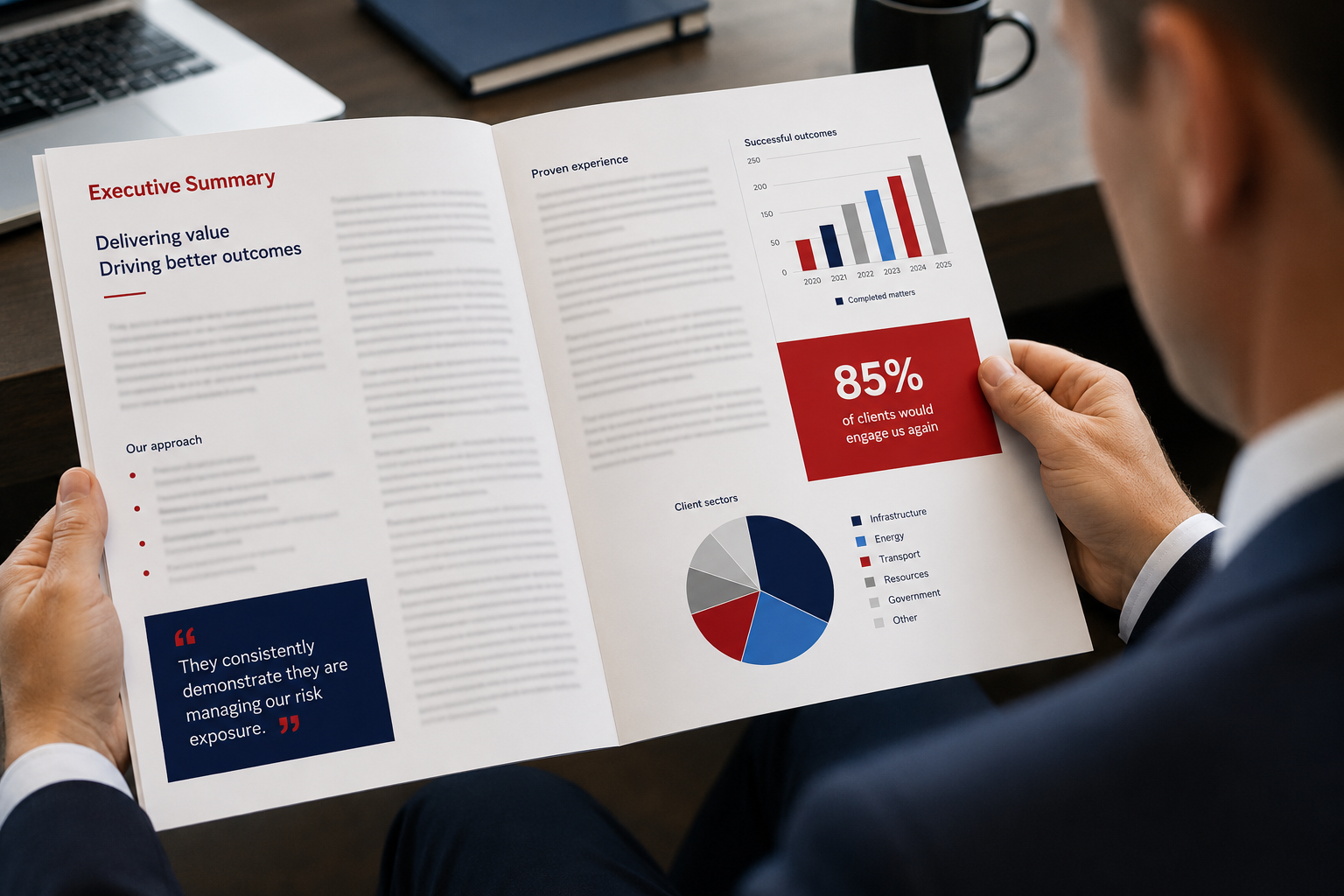
A decade ago, capturing business development and client data was a point of difference for many professional services firms.
In 2026, data is not what’s scarce. The competitive advantage comes from interpreting it intelligently – being able to extract precise, persuasive and client-relevant evidence on-demand.
A tale of two submissions
Think about it: you have two professional services firms pitching for the same piece of work:
Firm A, the more commercially mature organisation, submits a proposal that is rich with comparable project examples, testimonials from clients within the same sector, performance statistics, and relationship history.
Firm B submits a proposal that reads more like a generic brochure.
In competitive tendering—or even less formal business development efforts—every statement must be supported by proof.
When asked about value-added services, most firms copy what was in their last submission, presenting an unoriginal, largely value-less, list of offerings. Leading firms tailor their value-adds to the opportunity, and when re-tendering for an existing client will extract from their CRM system a detailed engagement history for all key stakeholders.
When asked about local sourcing, many firms resort to generic statements of intent. Leading firms analyse their workforce, suppliers and client base by postcode, and then graphically present their contribution to the region in question.
When asked to demonstrate their knowledge of an industry sector, most firms claim the sector is one of a handful it focuses on. Leading firms segment their client base by industry, disseminate sector-specific content, and demonstrate practitioner involvement in relevant associations, steering committees and taskforces.
Procurement is fundamentally about risk
Whether in business or government, procurement teams must demonstrate they are acting ethically, transparently and objectively. Evaluation processes are therefore designed around evidence-based assessment frameworks, weighted criteria and defensible scoring methodologies.
Procurement teams are not merely buying capability – they are mitigating delivery risk.
That is why generic capability statements are becoming less persuasive. Sophisticated buyers increasingly expect evidence: comparable project experience, quantified outcomes, sector-specific credentials, relationship history and proof of delivery capability.
In high-value procurements, probity advisors are often appointed to oversee governance and ensure evaluation integrity. Evidence does not simply strengthen submissions—it helps evaluators justify decisions.
AI-era differentiation
AI-powered proposal tools can now generate competent generic submissions in minutes. That is rapidly eroding the value of boilerplate capability statements.
Platforms such as Loopio, Responsive (formerly RFPIO) and Qvidian can assemble credentials, manage content libraries and automate elements of proposal production. AI-native tools such as Inventive AI and AutoRFP.ai can summarise case studies, generate compliant first drafts and accelerate response development.
As these technologies become more sophisticated, the competitive advantage is shifting away from content production and towards extracting precise, persuasive and client-relevant evidence from within an organisation’s own systems.
The highest-paid and most sought-after bids and pursuits professionals are increasingly those who can:
- identify differentiating evidence
- operationalise institutional intelligence
- tailor submissions to client risk profiles and
- craft compelling narratives that tie it all together.
Not so long ago, while consulting to a global law firm, I led a major opportunity that spanned the infrastructure, transport and energy sectors. The prospect, a listed company, had long been a client of arguably the most prestigious law firm in Australia, but was open to switching. Our submission involved an intensive analysis of what the project would entail, and an interrogation of the firm’s systems to identify those who had experience which was recent, as well as precise. It paid dividends. Millions.
More recently, a friend from the same firm revealed that internally the proposal is still regarded by the CMO as best practice. Yet, the CMO bemoaned that so little of the content could be reused.
That’s exactly how it should be: your tenders should be so client-centric, so project-specific, that others can’t cut and paste from them.
Conclusion
Data provides evidence, and evidence mitigates risk. I have proof of that.