

In many organisations, collaboration has improved. Decision-making has not.
Recently, I was working on a project for a large organisation with a hard delivery deadline. The steering committee had increased the frequency of meetings as pressure intensified — which made clarity, efficiency and decision-making increasingly important.
Like many modern project environments, the committee brought together people from different disciplines, operational backgrounds and levels of governance experience.
I missed a committee meeting and when I reviewed the minutes afterwards, one thing immediately stood out: the language of decision-making had quietly shifted.
Instead of:
“It was agreed…”
or
“The steerco decided…”
the minutes were filled with:
“I think…”
“Perhaps we should…”
“Maybe…”
On the surface, this might seem harmless – collaborative, even. But it pointed to something much more significant: the group was beginning to blur the distinction between contribution, feedback and authority.
This phenomenon is not confined to governance committees. I increasingly see the same pattern across corporate and marketing communications and in project environments such as bids and pursuits.
A document is circulated for approval.
Twelve people provide feedback.
Some comments are mandatory. Others relate to legal risk, strategic direction, personal preference or simply people thinking out loud. But rarely is the authority basis of the feedback made explicit.
Subsequently, the person managing the process is left trying to interpret: Is this a directive? A recommendation? A preference? A risk concern? Or simply participation?
The result is familiar to almost anyone working in a modern organisation: contradictory edits, approval bottlenecks, diluted messaging, prolonged delivery timeframes, and increasing frustration on all sides.
In most cases, people are contributing in good faith and, ironically, many of these environments are highly collaborative. The problem is that collaboration and decision-making are not the same thing. Organisations need a shared language for distinguishing between input, preference, expertise and decision-making authority.
McKinsey has written extensively about the operational drag created by unclear decision rights and overly complex stakeholder environments. One of their more useful observations is:
“Give more people a voice, but fewer people a vote.”
That distinction matters because many organisations now operate in a state where everyone is consulted, everyone contributes, everyone edits, but nobody is entirely sure who actually owns the decision.
In some environments, broad consultation becomes less about improving decisions and more about diffusing accountability. Participation increases, but ownership weakens. Everyone contributes, yet nobody feels fully responsible for the outcome.
The same pattern often appears in strategic tender responses. A client convenes a meeting with 12 or more senior stakeholders in the room. The meeting runs well over time. Everyone contributes, but it is obvious that not every view carries equal authority — and, more tellingly, decisions made in the meeting are often overridden the following day. That is not simply inefficient meeting management, it is a sign that the organisation has not clearly distinguished between input, influence and decision rights.
In communications environments especially, this creates a subtle but significant problem: feedback becomes flattened.
A legal risk comment is treated with the same weight as a stylistic preference.
An executive preference carries equal visibility to a strategic recommendation.
A tentative observation becomes interpreted as required action.
Over time, organisations start confusing consultation with authority; contribution with accountability; and participation with governance.
Harvard Business Review and Gartner have described this phenomenon as “collaboration drag” — where excessive consultation, meetings and stakeholder involvement begin slowing rather than improving organisational performance.
Most organisations attempt to solve this operationally such as by introducing more workflow tools, approval layers or collaboration platforms. But often the issue is behavioural and structural, not technological.
One practical way to improve organisational clarity is to become more explicit about the nature — and authority — of feedback itself. For example:
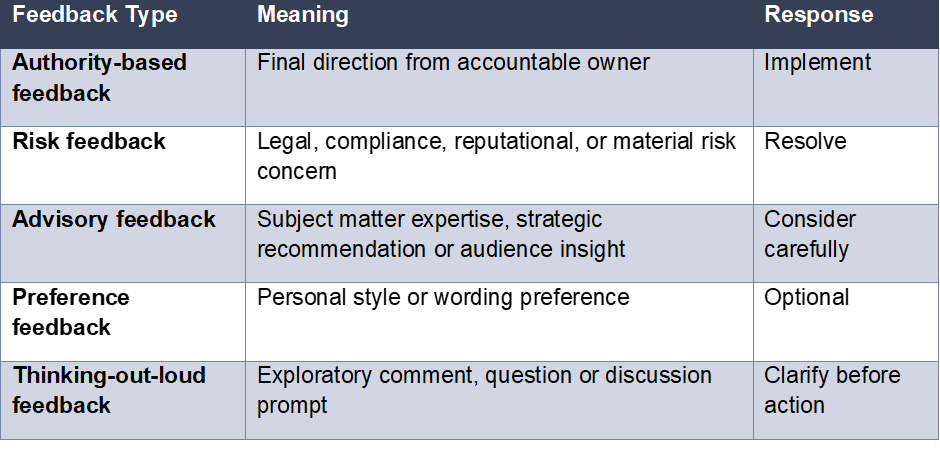
This may seem simple, but it changes the quality of organisational communication considerably.
Not all feedback carries equal authority.
And when organisations fail to distinguish between input, influence and decision-making, accountability begins to blur. Ownership weakens. Communication becomes cautious, diluted and increasingly difficult to finalise.
Good collaboration gives people a voice. Good governance makes clear who has the vote.